
One of the most satisfying hobbies is building hot rods and custom cars. Besides building them, the other rewarding thing about having these cars is driving them. However, the price of fuel lately is making these vehicles much less enjoyable to drive. For those of you who don't have trailer queens and like driving your cars as much as possible, the hot 8-cylinder engines typically in types of cars are definitely not a pleasure to refill at the pumps.
Hot Rodders (if their emission regulations permit it) very often upgrade from the original low-performance and often worn out carburetors. These upgrades can vary from the low budget replacement of the original 2bbl carburetor with an OEM 4bbl carburetor to the installation of a pricy aftermarket EFI system. The keys to high performance are excellent fuel mixture control and perfect fuel distribution.
In the quest for more performance, engines are often given higher compression ratios (CR), especially in conjunction with hotter camshafts. Hand-in-hand with higher CR is the need for more octane. At the pumps, 91 octane is reasonably common. 93 and 94 octane is also available, less commonly but at a much higher price. For even higher octane, you need to fill up at the airport or your local racing fuel supplier. Definitely not very convenient.
Rather than spending a pile of money on high performance carburetors and then later on high octane gasoline, please consider the option of using propane in your hot rod. As you've seen at the top of the Personal Car Conversion page, propane is extremely common in Canada and the USA. Although refueling sometimes takes a bit more planning than filling up at the first cheap station you see, this is no different than having to look for aviation or racing fuel. Actually, finding propane is a lot easier than finding aviation fuel and a lot cheaper too. In some places, propane is easier to find than Sunoco Ultra 94. Remember, propane has an octane rating of 104 and generally costs less than the cheapest grade of 87 octane anywhere.
What about performance?
Yes, your maximum horsepower will be slightly less with propane than with that expensive new 4bbl carburetor or that very expensive new sequential injection system. How much less, probably around 10%, depending upon which systems you're considering. The great thing about propane systems is that there is no need to spend a lot of time dialing-in the jetting on these carburetors. These things bolt-on and work perfectly out of the box.
The only adjustment on an air-valve carburetor is the power mixture and the idle mixture. Ideally, the power mixture should be set on a chassis dynamometer but a stop-watch and an eye on the speedometer will do. The idle mixture should ideally set with a CO analyser but a tachometer and/or vacuum gauge will work fine too. Once set, you're done until you make more modifications to the engine. The Impco Model 425 carburetor kit is suitable for mild performance applications on 350 CID engines and 325 hp.
For bigger engines or hotter 350s, an excellent high performance carburetor was Technocarb's 4bbl carburetor kit, which was available for applications requiring up to 810 CFM and 800 hp. For street-driven vehicles, this carburetor gives excellent performance on large big block engines. For the feedback Technocarb 4bbl carburetor, the included Scan Tool was used to initially configure the system. Like the air-valve carburetor systems, once set, you're done until you make more modifications.
Remember, propane carburetors are not over-sized like gasoline carburetors. Assuming a volumetric efficiency of 85%, a 350 CID engine only requires a 460 CFM propane carburetor @ 5344 RPM.
How about doing something different?
When you go to a car show or a cruise night, do you notice that just about every engine looks the same? Basically, if you're not using the OEM carburetor, the cars all seem to have either a Holley or an Edelbrock 4bbl carburetor. Guaranteed, if your car is sporting a propane carburetor, you will have the most unusual (and best DIY-engineered, in our opinion) fuel system. The Impco Model 425s are unusual but the Technocarb 4bbl carburetor would be the best looking.
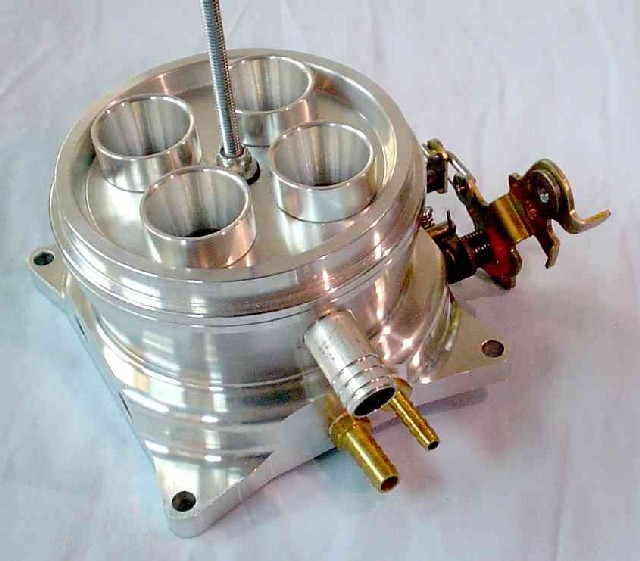

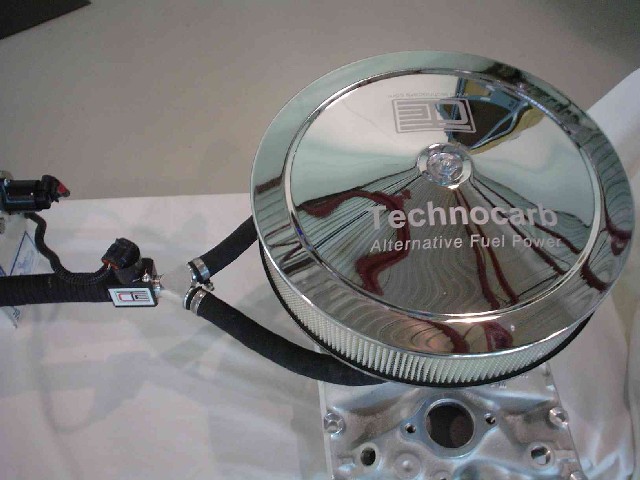
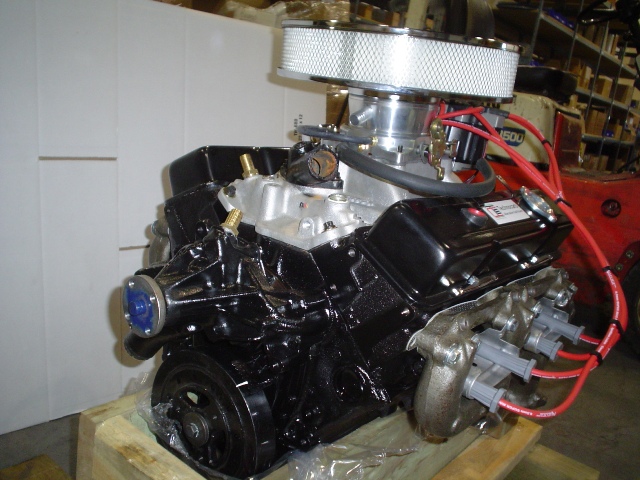
What about the cost of converting?
Well, that's a very real consideration. You really should be thinking about the cost for NOT converting. If you hardly drive your car, it doesn't make any sense to convert to propane. If you do, the amount of time it takes to pay back the conversion cost depends upon several factors.
The difference in cost between propane and the gasoline you need for your engine is a major factor. If you're buying propane for 65¢/litre and 94 octane is selling for 130¢/litre, you're looking a substantial savings. Because propane carburetor conversions typically get around 80% of the vehicle's gasoline economy (even though propane has about 75% energy per litre or per gallon compared to gasoline), your fuel savings are closer to 49¢/litre.
If you do the work yourself and have a professional to inspect your work when you're done, you can expect to spend around $3000 (underhood parts, fuel lines, tank, etc) on an 400 hp propane conversion. This seems pretty expensive at first glance but let's just check the payback. Let's assume that our car gets 15 mpg (US gallons - 3.785 litres) or 3.96 miles/litre on the highway. We're using miles because hot rods usually have odometers calibrated in miles. At $1.30/litre, our car will cost us $0.328/mile on the highway.
Since most Hot Rodders spend money on a new performance carburetor anyway, the cost of a propane conversion should really be reduced by that cost. For the sake of argument, let's say that the fuel system (carburetor, air cleaner, fuel pump) costs $500. That makes our $3000 propane conversion effectively only cost $2500 more.
We can expect to get 12 mpg (3.17 miles/litre) on propane from our 15 mpg car (15 mpg x 80%). On propane, we can expect our car to cost us $0.205/mile, a difference of $0.123/mile. In this example, our car will take about 20,325 miles to pay back. However, this assuming highway mileage.
In the city, you're going to use a lot more fuel and many hot rods do a lot of city driving. Let's say that our city economy is 3/4 of our highway fuel economy, which means we only get 11.25 mpg in the city with our car. In this case, we're looking at around 15,245 miles to pay back our conversion. If you drive your car every day, you could easily have a 1-year payback and your engine will have reduced maintenance and will last a lot longer. Besides, there is no guarantee that your new performance carburetor will get you better fuel economy.